February 24, 2015

Digestion Does Not Begin In Your Mouth: Your Brain on Hand Food

Potato-garlic pierogis and spinach.  Applesauce on the side.

I wouldn't call pierogis "hand food."  (Pierogis, if you don't live in parts of Brooklyn or Buffalo or another Polish community, are dumplings filled with mashed potato, or potato plus another ingredient -- common fillings include spinach, mushroom, meat, or, as Veselka has mastered, sweet potato).   They're eaten with forks, slathered in applesauce, sour cream, and/or sauteed onions.   Still, when I cook up a portion, I can't resist eating part of one with my fingers.  It just tastes better.

I'm like that with other non-finger foods, as well.  Roasted potatoes.  Brown rice.   Beans.   Lasagna.   Broccoli.  Most of this is done while cooking just for a taste but sometimes after the meal, too, while putting leftovers away.  And I've been known to outright "eat with my fingers" at my desk at work when no one is looking. :)

I am convinced food really does taste better "from hand" to mouth.  One of my theories is that the food gets closer to your nose, thereby ramping up the eating experience.

Not quite, but almost.   I discovered (after looking into this -- surely I couldn't be the only person willing to admit I'm an enthusiastic hand-eater) scientists are finding a connection between how you eat -- with your hands or with a utensil -- and how the brain responds.   Indeed: the act of picking food up with your fingers triggers a response to the brain and your guts -- your second brain -- to get ready for digestive action.   It's a more "whole body" experience that encourages mindfulness while eating -- you are really engaging with your meal.

Gastro Note:  I've found pierogis are a favorite "easy to digest" food of mine.   When my guts are churning, if I have nausea or other gastro issues, I can always tolerate and enjoy pierogis.  Sometimes it gets crazy -- I've had weeks where I've wanted nothing but pierogis for three days in a row!  (They are insanely delicious, especially in my neighborhood, where they are made fresh just down the street.  The "pierogi factory" -- really! -- makes a few varieties but my favorite is garlic and potato, which are also vegan.  Yeah!)  I eat mine with applesauce -- double points if I've made my own applesauce that week!


SOME LINKAGE ON THE SUBJECT...

NPR's The Salt:  Is Everything More Delicious When You Eat With Your Hands?

Express Tribune:  5 Reasons Why You Should Eat With Your Hands

HinduismToday:  The Ways and Joys of Eating With Your Hands

HinduHumanRights: Vedic Wisdom Behind Eating With Your Hands

Organic Olivia:  How Eating with Chopsticks Massages Your Organs and Stimulates Digestion  An interesting related article...

NY Times:  Mind Your Manners:  Eat With Your Hands

SFGate: A New, Old Restaurant Trend: Eating With Your Hands


January 4, 2015

New Root Soup for a New Year!

New Roots Soup Recipe (see below for recipe)


Cranky Gerd is back!  I've updated the description of my blog to include Gastroparesis -- also known as "slow stomach emptying" or that unfortunate phrase, "lazy stomach."   After months of assuming I was suffering from "GERD,"  my doctor and my own self-observation realized it's not quite GERD that's the problem -- it's the more ambiguous gastroparesis.   In short, things don't move quickly enough through my GI tract.  Sometimes things get log-jammed in the stomach itself.  Other times, my intestinal tract is sluggish and there is "no movement" -- despite the healthy amounts of fiber, liquids, dried fruits, caffeine, and other traditional remedies.   This results in bloating, pain, gas, and overall feeling awful!  On a bad day, nausea can join in the fun. 

Gastroparesis is not just a physical discomfort -- it's a ridiculous waste of time, an annoyance, and emotionally draining.  Like right now, for instance.  I am supposed to be out the door in 10 minutes to have a relaxing Sunday, but my GI tract feels bloated, gassy, heavy -- I have to "go" but nothing is working "out."  Argh!  Do I leave the house like this and suffer for hours?  Or hang around for hours, possibly (most likely) for nothing but more waiting around until my guts decide to take action? 

This year, Cranky Gerd will continue to share my GI journey, and as in the past, recipes and tips for a healthy gut (or what works for me, in any case).   I'll also include "off topic" posts from time to time because 1) it's my blog :)  and 2) these things may be of interest to others here too, as we are not just our GI tracts!   :) :) 

So…

The first recipe of the year:  new root soup.   Inspired by the new roots emerging in the greenmarket these days, and the need to "de-tox" a bit after the holiday onslaught of treats, I tossed this soup together this morning.   Stay clear of salt, be stringent with oil, and enjoy the roots' naturally mineral-rich flavors and nourishing goodness. 


NEW ROOTS SOUP

This amount makes soup for a few portions -- depending how much you want to eat in one sitting.
Easily doubles or triples -- use a large pot to give the vegetables plenty of space to simmer.

  • 2 small sweet potatoes, scrubbed, peeled as needed, and cut into small chunky slices
  • 2 medium carrots, peeled and cut into small pieces
  • 4 medium potatoes, cut into thin slices (any non-Russet potatoes would work best)
  • 1 celeriac root, trimmed and cut into small chunks
  •  2-3 cloves of garlic, crushed or minced
  • 1 small leek, trimmed and sliced into small pieces  
  • 1 teaspoon olive oil
  • water

1.  Heat garlic and oil in soup pot at very low heat.
2. Add carrots, sweet potatoes, celeriac, and potatoes.  Cover pot and leave over low heat for 5 minutes to "sweat" the flavors together.  Mix occasionally to prevent sticking.
3. Add water -- use enough to cover about an inch above the vegetables.    Add the leek.
4. Bring to a boil, then reduce heat and simmer for 20 minutes or until vegetables are softened.
5. Stir occasionally throughout the simmering.   Add more water if needed -- you want the water to cover the vegetables just a bit so there is a nice broth going.
6.  The soup is done when the potatoes break up easily and the other vegetables are softened.  You can cook more or less to your taste.    Take a wooden spoon (or potato masher if you wish) and "mash" on section of the veggies in the pot to thicken the broth and add texture.
7.  Enjoy!   This is a nourishing but "light" root soup -- great as a prelude to any meal, or a snack between meals, or a light meal in itself.


June 18, 2014

On Hiatus! (See you in September!)


Cranky Gerd is on hiatus until mid-September!   Until then, browse the old entries, send me links or suggestions for future posts, breathe and nurture your guts and your whole bodies!   :)

May 16, 2014

Report From My Gut: Let's Talk Motility!


This blog entry is not for the faint of heart!

Time to talk "motility."   For people with GERD, gastroparesis, and other GI conditions, "not going" is not just uncomfortable -- it's a crisis.   One "slow" day can easily spiral into a few days, making my already challenged intestines and slow stomach even more cranky.   And, I have found that when I am constipated, nausea often follows.

This morning, I am on day three of feeling not my best.  

I do all the advised things.  I've done most of these in the last 24 hours:

  • Eat plenty of vegetables and fruits (Veggie diet -- check!)
  • Eat more fiber (that's ALL I seem to eat some days…)
  • Take probiotics (done -- in the form of pickles and Puehr tea…)
  • Exercise (stair-climbing daily, a few big walks each week, Tai Chi, stationary bike…)
  • Drink more liquids (water, non-caffeinated tea, caffeinated tea, more water)
  • Relax (trying!!  trying!!  trying!! but easier said than done when the clock is ticking and I need to leave the house for work -- bloated, again!)
Now it's less than 40 minutes to my departure time and I need to shower, get dressed, pack my lunch, and head out -- but who wants to schlep to work feeling like you've got an extra 29 pounds in your gut?  Gassy.  Crampy.  Psychologically bloated.   I don't like using public restrooms (who does?) and with "gut issues" it's just better dealing with things at home, trust me.

So, this remains an ongoing issue for me.  For months, I had somehow settled into a routine and constipation was occasional.  It is upsetting to be back in this situation, worrying where and when my next bowel movement will be!   If I "take too long" in the morning, that can prevent me from meeting my exercise goals -- a 45 minute walk before work, or my Tai Chi class.   It's a daily struggle.

One comfort:  If you are reading this and experience the same issues, you are not alone.  Constipation is one of the most common concerns, and one of the least discussed.  It may not be "life threatening" but it is definitely life-impacting.


WHAT OTHERS ARE SAYING -- LINKAGE 

A few interesting and helpful online resources:

Silent Struggles: The Ugly Truth about Gastroparesis and Constipation

Gastroparesis FAQ:  Constipation Causes & Remedies.  Video from Living With Gastroparesis blogger Crystal Saltrelli, Certified Health and Nutrition Counselor

Excellent graphics and information are included in this Constipation Fact Sheet by the Bladder and Bowel Foundation 

Australian Government Initiative: Looking After Your Bowel -- A Guide to Improving Bowel Function.  A whole government-issued document on the subject!  More good graphics here.


April 14, 2014

Linkage: Mind Over Stomach (and Everything Else)

I heard a story this morning on NPR about how putting different labels on the same milkshake caused different physiological reactions in test subjects' stomach responses.  Fascinating stuff.  See below for the link.

How much of our body's response to food is in "our minds?"   And, if there is a placebo effect, is this a bad thing?  How can we leverage this unreality to our benefit?   I say if it's "just" the placebo effect, well, great!  Feeling better and improving your health without medication side effects -- absolutely!  

But -- as you know if you're suffering gut issues, the stomach IS a second brain -- will this make the expression, "it's all in your mind" even more frustrating when there is scientific evidence to back this up?


LINKAGE:

Mind over Milkshake: How Your Thoughts Fool Your Stomach (From NPR, 4/14/2014)

Placebo Effect in the Treatment of Duodenal Ulcer (British Journal of Clinical Pharmacology, 12/1999)


Radiolab: Guts (Season 10, Episode 7)


Nortriptyline No Better Than Placebo for Gastroparesis Symptoms (American College of Surgeons News, 5/2013)

Homeopathy is Bunk, Study Says (The Guardian, 4/2014)

April 1, 2014

Recipe: Root and Tuber End-of-Winter Soup


Roots and tubers soup

Got roots?  Got tubers?  Make soup!

After weeks of snow, vortexes, and overcast skies, though, even I've had enough of the roots and tubers -- the only vegetables at my greenmarket, for the most part.  As much as I love a good sweet potato, I've had it!  Except, we were still having it.  As I've noted elsewhere on this blog, our household gets most of its produce from the farmer's markets.  It's a fun challenge to eat locally and seasonally (though I have in recent weeks dipped into the hothouse greens -- I just needed some fresh leafy stuff.)

Inspired by our winter produce bin, I created this root soup, which is also inspired by my effort to avoid getting sick.  Everyone I know has come down with a cold or "flu."  I've felt fine all winter, which I attribute to my "anti-inflammatory, immune-boosting" diet hacks like large amounts of garlic, onion, cinnamon and ginger.    This soup includes a shallot, garlic, and lots of nutrient-dense roots and tubers.  It's also well-cooked, an easy to eat soup for the sensitive stomach and esophagus.  I'm still doing well with foods that are somewhat softer, more gruel-like.

ROOT AND TUBER END-OF-WINTER SOUP

Ingredients:

1 large shallot or a few small shallots, chopped
3 cloves garlic, pressed or minced
2 medium sweet potatoes, unpeeled, sliced and diced
1 large parsnip, peeled, sliced on the angle
2 white potatoes (Yukon are especially good here), unpeeled, sliced and diced
1-2 tsp olive oil
1 apple -- optional (I have not tried the apple addition yet, but initially thought it would work well)

Ingredients for the soup. 

  1. Add 1 tsp oil to a large pot.  Cook over low heat and add the garlic.  When fragrant, add the onion and cover, stirring occasionally.  Cook for a few minutes, or until softened.
  2. Add the sweet potato and parsnip.  Stir and cover, cook for a few minutes until fragrant.  Add a small amount of water if sticking to pot.
  3. Add potatoes and stir.
  4. Add water to cover pot contents by 1-2 inches.
  5. Bring to boil and lower heat, simmering until vegetables are softened and "come together." (There's a point when making soup when the contents of the pot go from being "ingredients in water" to "soup" -- you'll know it when you see it, and you'll probably smell the change, too.)
  6. If using the apple, chop into small pieces and add when you add the water.  (If you try this addition, let me know how it goes.)
  7. If needed:  When vegetables are softened, use a potato masher to mash a small section of the pot's contents.  This thickens the soup a bit and provides interesting texture.  You may find the soup is already "thick" enough, to your taste, in which case omit the masher step.
Serve warm with bread or crackers of your choice.


MORE ON ROOTS AND TUBERS

Mother Nature Network: Root Vegetables 101 Primer

Healthy Home Gardening's article on The difference between roots and tubers

Oh My Veggies A Guide to Root Vegetables

Visual Dictionary: Tubers 

The Good Root Guide (Daily Mail)


March 10, 2014

March Madness

Winter comfort -- wonton soup at Peacefood.

Winter is one of my favorite times of the year -- one can wear turtlenecks, walk briskly without sweating, and have an excuse to drink hot chocolate!    Still, this winter has become tiresome here in New York!   Is that why I've stopped blogging for several weeks?  Or is it the exhausting pace of life lately?  I recently read another blogger's post about letting her blog unexpectedly "languish" and how she begs readers to forgive her.   That's how I feel -- I'm thinking of you all, really!   Each week I resolve to write a new post but "life happens."  

Well,  onward!

RECENT DISCOVERIES

My motility issues have worsened over the past weeks, along with my stress levels, daylight saving time, winter weather, and a hectic schedule.   Thankfully, I discovered respite with a few events and resources:

1)  The big bowl of vegan wonton soup from Peacefood -- pictured above.   If you are in NYC, go and order a bowl!  I tried this one evening and now it's a daily craving, salve for any colds, winter doldrums or nervous stomachs.  The broth is a miso base full of carrots and slivers of other sweet tasting vegetables, and the wontons are full of ginger, tofu, and more vegetables.

2)  MooShoes' Whalentine's Day bake sale benefiting the Sea Shepherd Conservation Society (those amazing folks who take direct action to save whales and other sea creatures from death and injury).   Here is our cheerful take-home stash of vegan cookies and bread:

Part of my Whalentine's Day Bake Sale stash.


No visual for this one but the other day (after our Peacefoods wonton soup meal) J. and I wandered 14th Street and discovered Namaste, a bookshop owned by people formerly involved with the terrific East-West bookstore that closed a few years ago.  Near Union Square, Namaste is well stocked in goods and good energy -- shall I take a sound meditation class?  I think so!

More to come...

January 2, 2014

Recipe for the New Year: Skillet Black-Eyed Peas with Chard and Carrots


Cast iron makes everything better!


New Year greetings!  Here's to happier guts and marvelous motility in 2014!

The past weeks have been challenging for me, with constipation issues returning, and a rise in reflux (no pun intended).  I actually woke up last week to foul stomach juices in my mouth -- scary and demoralizing and just plain icky.  Why now?  I'm ruling in "stress," since I have a few very stressful personal situations coming up.   And diet:  all that dairy and processed foods and sugar and sodium from meals out and decadent meals in.  Already I feel restored after a week of my "minimal" cooking.  (Constipation is better, reflux is so-so but getting there, and overall weight and bloat is much better.)

For the first day of the new year, I ate well and had no issues.  Lunch was at Le Pain Quotidien where I got a tofu scramble.  (You know I am a sucker for tofu scramble in general, so this was a must-order.)  I asked to hold the soy cheese (but I would have had it with Daiya) and the mushrooms, which left me with scallions and tomatoes -- a deliciously minimal dish, fluffy and soft tofu with no silly yellow spices to simulate "eggs" nor any harsh flavorings to "distract" from the simplicity.   Here is one blogger's review of her tofu scramble, which includes a photo.   And, here's a post by blogger Lemons-Life-Love, who offers her own tofu scramble recipe.  

(Side rant:  Why must EVERYTHING in restaurants be smothered in "flavor?"  The bane of my cranky gut.  Bland is not bland when the ingredients are high quality.  I call it enjoying"the flavor of the food."  Le Pain understands.  :-)  )

For dinner, I made this concoction using a box of frozen black-eyed peas and fresh greenmarket carrots and rainbow chard.  It was a success, to be repeated beyond January 1! 

RECIPE:  SKILLET BLACK-EYED PEAS, CHARD AND CARROTS Use greenmarket ingredients when possible!


1 T olive oil (or less oil, if possible)
2 cloves garlic, chopped
1 bunch chard, sliced (I used rainbow chard, but any color/combination will do)
2 large carrots, diced into large chunks
2 C. black eyed peas (I used a small box of frozen ones, but canned or even better, fresh, would work)

1. Saute garlic over low heat until just browning.
2. Meanwhile, boil frozen block of black eyed peas in water 15-18 minutes until done.  If using canned or freshly made "fresh beans,"omit this step.   Drain.
3. Add chard; cover and steam-saute until wilted.  Stir frequently to prevent sticking.
4. Add carrots and a bit of water; cover and steam-saute until carrots begin to soften. 
5. Add black eyed peas.  Add water (enough to just cover bottom of pan -- to moisten but not drown everything).  Cover and cook over medium-low heat for 10 minutes until heated and flavors blend.  The longer the better...!
6. Serve over a grain or pasta.  

Close up of everything coming together.

November 14, 2013

Fun with Portion Control!

Portion control is easy when your dishes are this pleasing!

Portion control is key when you have digestive issues.   We should all be eating more slowly, chewing each bite longer, and serving ourselves smaller portions for healthy motility.  In my case, these simple acts make a huge difference in reducing GERD (or eliminating it altogether).   Lately, I've been catching myself eating quickly, and eating beyond feeling full -- often, as I'm putting food away I eat a few extra bites, or I decide I want "just a little spoonful" more after finishing my plate.   Those few extra bites make an impact -- how many times have I felt great at the end of my meal, but then "bloated" and uncomfortable after not listening to my body?  (And, I seem to never learn!)

It is never too late to take a breath and re-train yourself to eat more slowly and mindfully.  Don't fret about past days or weeks.   Focus on today.   

SECRET WEAPON: MY JAPANESE CERAMIC BOWLS

I have been using 1 or 2 cup sized Pyrex glass containers for my lunches -- and the occasional mason jar.   A few months ago, my portable lunch container world shifted when I discovered these Japanese bowls at the inimitable NYC store, Pearl River:


Fantastic lidded bowls from Pearl River, NYC.


Microwavable, with lids, they are made from ceramic -- not lightweight to haul around, but I long gave up plastics, so I'm used to my lunch sack containing sturdy containers.   And, eating lunch in one of these is an aesthetic joy!   The craftsmanship of these bowls inspires me to take my time, enjoy my food, eat mindfully.

EATING OUT:  A FOOTNOTE

Often, eating out with GERD -- or any digestive/diet related concern -- is an ordeal.   J. and I usually dine out at "healthy" vegan or macrobiotic restaurants because we can choose most everything on the menu (a pleasure!), and the dishes are not overly spiced or too salty (though since our home cooking is mostly salt-free, anything remotely salted can be "too" salty for us). 

Restaurant portions are still too large, even in most vegan/macro places.   I wind up taking half home for lunch (not that bad an end).   One recent meal, however, was perfect.   At Blossom, a vegan bistro in Chelsea, NYC, I did not feel overwhelmed at the table by the portion size, and could simply enjoy and focus on the food, completely.  (Another effect of "too-large portions" in restaurants -- I get overwhelmed by the idea of having to finish it all, or the logistics of now having to take half home -- what if I don't feel like schlepping my half-eaten food across town?   Large portions become an emotional burden!)

At Blossom, we had the "tofu benedict" and an order of French toast with fruit.  We split each plate, and the amount was ideal:  about "two fistfuls" of food each.  (Maybe a bit more -- but we did not have busting guts and I had no nausea, regurgitation or other GERD calamities afterward.)   Here is what our breakfast looked like when it arrived:

Brunch at Blossom.


November 5, 2013

Linkage: More Gut Flora in the News

A few months ago, I posted about the increasing awareness of how the microbiome impacts one's gastrointestinal, and overall, health.   Since then, I've been on the hunt for more microbiome information, and get giddy when I come across new resources.   A few of the recent finds:

October 20, 2013

Recipe: The Best Breakfast Cookie (or Homemade Bar or Vegan Oatmeal Cookie)

My first batch -- which I could not stop eating!


For years, I have been trying to find a granola or bar-like snack that is tasty and meets my high standards:  peanut-free, soy-free, sugar-free, minimal fat, and vegan.   Whew!  I found one -- and it's my own hybrid recipe of Glow Kitchen's Easy Oatmeal Vegan Cookie and The Minimalist Baker's "breakfast cookie."    I agree with John and Dana (the Minimalist Bakers) who confess these "turned out so good I simply could not stop eating (as in "6 cookies in one day" kind of good)."    Glow Kitchen calls this a cookie but I think it's closer to a terrific granola bar alternative!

BEST BREAKFAST COOKIE / HOMEMADE BAR / VEGAN OATMEAL COOKIE

Ingredients

1 and 1/2 C. oatmeal (I used Quaker Oats, regular variety)
2 tsp cinnamon
1/8 tsp salt
3 small to medium browning bananas (mine were lightly spotted)
1/2 C. applesauce, unsweetened
1/2 C. raisins
1/3 C. unsweetened dried cranberries (I prefer these)
1/4 C. ground nuts (I used a mix of walnuts and pecans from Tierra Farm)

  1. Preheat oven to 350 degrees.
  2. Mix oats, cinnamon, salt, dried fruit and nuts.
  3. Put bananas into a large bowl and mash with a fork. Or, if you don't mind doing this with your hands, it's really the most effective way.  Just squish the bananas between your fingers…   
  4. Add applesauce and mix well.
  5. Add the dry ingredients to the wet ingredients and mix/fold together.
  6. Line a baking sheet with parchment paper.  (Critical -- cookies may stick if you do not use parchment paper!)
  7. Use a tablespoon measuring spoon to drop 2 T. of batter per cookie on parchment paper.  Shape into "cookie" shape if needed and lightly press cookie as dropping it onto pan.
  8. Bake for 25-30 minutes.   I left these in for an extra 5 minutes or so just until the first sign of browning on some of the cookies.
  9. Cool individual cookies on plate or rack.  
  10. KEEP REFRIGERATED.   I do not know the shelf life but it seems these need to be eaten relatively quickly.  Not that this will be difficult to do.  :)


The finished product, cooling! 

Cookies in Pyrex storage container ready for refrigerator.  The plated cookies never made it that far.


July 30, 2013

Secret Weapon: Saute-Braised Greens

"Dinosaur" kale from Paffenroth farms.

Greens are a constant on my table and in my guts.   I rely on them as a quick side, and for flavor and texture in casseroles and soups.   They're super-nutritious, easy to cook, versatile, affordable, and GERD-friendly -- what's not to love?   One of my favorite ways to use them is simply sauteed-and-braised, Southern style greens slowly cooked in a skillet with a bit of water (and I'll add a bit of olive or sunflower oil, though you can omit this according to oil-free recipes, or use vegetable stock in place of plain water for the braising).

Slow-cooking in liquid softens the greens to an irresistible melt-in-your-mouth texture, and mellows out any bitterness.    This method is great for all fresh greens:  kale, chard, spinach, collards, turnip greens, sweet potato greens, and whatever other greens come your way.

STEP ONE:  Prep the leaves

Rinse leaves.  For kales and other greens with chewy stems, remove all trace of the stem parts -- including along the inside of the leaves.  This is the key to achieving a smooth texture (versus a smooth mouthful of kale with jarring crunchy bits destroying the buttery mouth-feel).  Most restaurants do not go through this trouble, and I'm often disappointed by the results…

To remove the stem from the middle of the leaves, fold the leaf and grasp the stem, and pull… 


Soon, you will have a pile of leaves without stems… 


Gather the leaves into a pile, stacking them or bunching them in an organized heap.  Cut into slices with a large knife so you end up with strips or uniform chunks.


STEP TWO:  Cook the greens

I like to saute a few pressed cloves of garlic in a tablespoon of olive oil before adding my leaves.  Once the garlic is just starting to turn brown, add the greens.    Use a wooden spoon or spatula to turn the leaves so they start to wilt from the heat.  Keep turning a few times a minute until all the leaves are coated with the garlic/oil and wilting.


Add enough water to just cover the bottom of the pan, below the leaves.   You may add more water later -- the idea is to keep the greens in a thin layer of water throughout the cooking period, but not floating in water.  Cover with a lid and cook over low to medium-low heat, stirring occasionally, and adding more water as needed to keep the greens hydrated.    Cooking time will vary depending on the greens.   Taste periodically until done to your liking.


I did not take a photo of the finished kale I documented in the previous photos, but here is an example of Swiss chard after saute-braising.  In the case of chard, I am more generous with the stems since they soften quickly in the cooking process -- I don't need to remove the stems from the middle of the leaves, and even cook up a few bits of stem with the greens.

Served here with brown rice and red beans.


July 4, 2013

Linkage: Gut Bacteria and Gut Health

Another fascinating study of our microbiome was released today by researchers at Washington University School of Medicine.   Apparently, a sample of women's guts over five years showed little change -- indicating our gut microbiome is relatively stable (or stagnant?) over time, and suggesting our guts may carry bacteria from childhood.  Whew!  (For more information, visit Dr. Jeffrey Gordon's Lab Page.)  

I need to explore the microbiome studies more on Cranky Gerd.  I am getting obsessed with this topic and its implications!   Here are a few links to get us going.  I am still comprehending the fact that the human body's bacteria grossly outnumbers our human cells by the millions trillions.  

LINKAGE

NPR All Things Considered, July 4, 2013, Gut Bacteria We Pick Up As Kids Stick With Us For Decades

May 2013, UCLA Newsroom: Changing Gut Bacteria Through Diet Affects Brain Function


An article on the topic in the August 2012 Nutrition Action Newsletter, Living in a Microbial World

US News, September 2012, discusses study: Changes in Intestinal Bacteria Linked to Type 2 Diabetes

Homepage of the National Institutes of Health, Human Microbiome Project

New York Times, May 15, 2013, Some of My Best Friends are Germs, by Michael Pollan

The New Yorker, April 17, 2013, A Roller Derby of Bacteria

Microbiome, a scientific open-access journal

Probiotics, Prebiotics, and the Host Microbiome: The Science of Translation, a June 2013 webinar hosted by the New York Academy of Sciences (the webinar itself is not online but there is a wealth of abstracts, names and references here)

June 2013 Medscape video featuring microbiome researcher Dr. Scott Peterson talking about "The Microbiome: Linking Bacteria, Health, and Disease"

Nature: Human Microbiota special issue

Added 7/12/13:

New York Times, July 6, 2013, Why I Donated My Stool by Marie Myung-Ok Lee

June 25, 2013

Secret Weapon: Non-Dairy Milks, Again


Experiment: almond milk and vanilla...not quite there yet, but edible and dairy free!


First, a status update:  My recent GERD and gastroparesis flare up (belching, regurgitation, nausea, constipation, bloating) continues to subside, and I am feeling better!   I am being more mindful overall regarding portion sizes, eating slowly -- two factors that I think are the top reasons my GERD has subsided -- exercising more and differently (new strength training sets, and twice-weekly Tai Chi class), and choosing foods more wisely.

GOT (NUT) MILK?

I've further reduced my dairy milk intake
over the past weeks:  I've avoided eating foods containing cow's milk at parties, and I am ignoring the usual stream of cupcakes and muffins at the workplace.   And, options for desserts (my usual lone source of dairy at home) have greatly expanded with the purchase of a Cuisinart Ice Cream Maker!   We have just started to play around with this new machine, and are having fun experimenting with all sorts of bases, including almond milk and hazelnut milk.  (I think cashew nut milk will be the secret weapon for quality vegan ice cream, given the extraordinary results by Lula's Sweet Apothecary -- a NYC phenomenon which unfortunately may be closed/closing.  Lulu's is the only vegan ice cream maker I've found that uses cashew milk instead of a coconut or soy or banana (see Gentle World's post on frozen bananas!) or almond base.

So, is it the addition of our ice cream maker (and, consequently, increased non-dairy desserts) that is making a difference, reducing my GERD symptoms?   Another possibility is my reduced carb intake, something I decided to informally monitor lately.  Less carbs = less breads = less wheat.  Another variable?   (But, elaborate tracking charts aside, it seems GERD can come/go without rhyme/reason/the stars align in mysterious ways.  Does anyone else ever feel this way?!)

Making a note and wondering if I need to go on another food elimination diet to see what's up with that.

From around the web, some dairy-free resources/recipes:
  • YUM Universe's Dairy-Free Milk primer is a nice quick look at making and using dairy-free milks (including nuts but also sunflower, millet and rice!)
  • And the My Whole Food Life blog spotlights a vegan strawberry ice cream and is a good resource, overall, to "clean" eating.


June 12, 2013

Report from my Gut: Getting GERD Flare-Up Under Control with a Counterattack!

Did too many tomatoes do it?
What happened??!

The past few weeks, all of a sudden, my GERD symptoms rallied and returned, five-fold.  This, after months of feeling much better, no "clenched throat," no reflux episodes, little or no nausea, even my constipation had been resolved for the most part.   Now, constipation has returned.  Bloating, nausea, consecutive days of acid reflux shooting up my esophagus, rare for me even in my GERD flare-ups -- a daily occurrence.  

What caused all of this?  I'm still trying to figure it out.  Too many tomatoes?  Exceptionally stressful (good and bad stress) weeks?  A few constipated days too many?

After a week of chewing on TUMS and feeling miserable and demoralized, I had to take action.  Several days into my "GERD Flare Up Counterattack," I am getting back on track, and the symptoms are subsiding.

Here's the strategy I used to get myself back on track:
  • Eliminated my daily caffeinated tea and chocolate intake for a few days, choosing to drink chamomile-lavender and chamomile-vanilla, or lemon verbena, herbal teas.   When I resumed caffeinated tea, I selected pu-ehr and dark oolongs.
  • Mindful eating, focusing on GERD-friendly foods (I tend to do this as a matter of course, but made a particularly strong effort to focus on stomach-friendly ingredients): lentils, sweet potato, kale, chard, pasta.  I also re-incorporated greenmarket (pastured) eggs as meals, having hard-boiled eggs and sauteed kale for breakfast and a scrambled egg for dinner.   For lunches, I brought soup or an Amy's frozen meal. I tried to eat slower and smaller meals, noticing I'd been lapsing about this.  
  • Avoided tomatoes/tomato-based meals.  Was this the trigger for my reflux spell?  I bought two pints of sweet cherry tomatoes at the greenmarket -- the first of the season!! -- and gobbled them down, on their own, and in a salad.  I also had been increasing my tomato sauce intake, with more veg lasagnas and other dishes.  Usually, I'm lucky and can eat tomatoes without concern.  But maybe this was a case of too many, too soon, too fast.  I've also been eating a lot of strawberries, and tried honey with bee pollen -- a tiny taste that triggered an oral allergic reaction for 15 minutes.
  • JUST SAY NO policy at work.   I refused birthday cupcakes, leftover pizza, free chocolate, and other office treats.   (Frankly, I should maintain this policy, which is, overall, the best way to manage my GERD, diet, health.)
  • Tums.  Lots of Extra Strength TUMS.  I admit, they helped and I was determined to keep reflux away while I adjusted diet and other factors.
  • Engaged in "self talk," trying to calm my mind and coach my body into relaxing, feeling better, getting back in control.  Reminding myself "the nausea will pass" and just don't worry about the constipation, this will resolve as well.  
Slowly but surely, returning to "my normal."

June 3, 2013

Recipe: Tofu-Spinach Lasagna (Vegan)

My latest lasagna -- perfect flavors and textures.
Lasagna!  So easy, so tasty, so make-ahead, so GERD-friendly when it's dairy-free.  

Note on tomatoes:  Fortunately, they are not usually a concern for me, but I know a lot of GERD-prone folks can't handle them, gut-wise.  In that case, behold tomato-allergy friendly recipes!  I found a few interesting tomato substitutions, including carrot sauce and butternut squash.  There is a helpful no-tomato sauce thread on the IBS board.  (All of these sauce alternatives look wonderful in their own right!  Filed in my "to make" folder.")

While I'd tried to bake it here and there in the past years (with and without cheese), I decided to "master" vegan lasagna this year.  I flipped through cookbooks and blogs to help guide my own construction of these magical layers, and fine-tuned my recipe after experimenting with three lasagnas. Here are my results.

TOFU-SPINACH LASAGNA (VEGAN)

My second effort -- good but still not quite there yet.

Inspired by versions in Isa Chandra Moskowitz's Veganomicon, Mark Bittman's How to Cook Everything Vegetarian, and my experience with my family's lasagna-making, I came up with this recipe.   It avoids nutritional yeast (I just haven't incorporated this into my diet yet) and "fake cheese" (too processed for my palate and mind).  I use a square 9 x 9  sized glass pan (in 2 cases, I used the foil pan which came with the lasagna noodles), which serves four as a main dish, along with a vegetable side.   A small salad, broccoli, or dark leafy greens such as kale or -- a new Farmer's Market favorite -- spigarello -- go especially well.

Ingredients and Steps

Preheat oven to 350 degrees.

Boil the Pasta (or Don't)
6-8 flat sheets or enough of any lasagna noodles to make three layers in your pan (I used "no boil" lasagna for the last 2 lasagnas I made -- my first no-boil effort, ever -- and liked them best.  The brand I tried was Delverde, which packages its pasta with two disposable foil pans.   My personal preference is for flat lasagna, not curly, but it's an individual choice.)

Make the Sauce
Use your favorite prepared sauce, or make your own.  I tried a prepared sauce, a quick marinara that I made (using a recipe from Isa Chandra Moskowitz, again), but the best lasagna was the one using my mother's homemade, 4-hour simmered vegetarian tomato sauce which she made/left for me on her last visit.  She promised to share it with  me, and I'll post it here.

Prepare the Filling
1 block firm tofu
2 t. lemon juice from fresh lemon
1 T. chopped fresh parsley
1 T. dried basil (I have not tried this with fresh basil, but I am certain it would be even better!)
1 t. dried oregano
1 T. olive oil
pinch of salt
Mash the tofu into a ricotta-like texture. (I like using my hands for this one, but use whatever you're comfortable with -- a fork, spoon, etc.)   Add the rest of the ingredients and mix. 

Simmer-saute the Spinach
Spinach -- the amount varies, depending on your taste and pan size.  You want enough spinach to make at least one good layer, then a bit more spinach for the top layer.
Prepare the spinach:  if frozen, just rinse with water to lightly thaw and add to pan.   If fresh, wash/chop.  Heat olive oil in pan (cast iron is ideal) and simmer-saute in olive oil on low flame, covered.   Let simmer for 10 minutes or until soft and "sweet."  Set aside.   Sauteing the spinach is a key step!

Compose the Lasagna
In a 9x9 pan (or whatever pan you have/need for the desired quantity), sprinkle olive oil on the bottom and then top with 1-2 ladlefuls of sauce.

Cover bottom of pan with lasagna sheets, using smaller pieces if needed to cover entire bottom.

Next comes a generous layer of sauce, and then 3/4 of the tofu filling.  Press the filling slightly to help it hold together.  Sprinkle with 2/3 of the spinach.

Another layer of pasta, followed by sauce, and whatever ricotta filling and spinach you have left.  Top with one more layer of pasta, more sauce, and drizzle a teaspoon of olive oil on top.

Baking Instructions
Cover pan with foil.  Bake lasagna at 350 degrees for 25 minutes.
After 30 minutes, remove foil and bake for an additional 20 minutes (or longer).  The top should be slightly browned (or cook to your preference).   I'm notorious for sticking a knife/fork in the center and gouging out some of the middle to see if "it's done" (holding together, bubbling) but after 50 minutes you should be okay.

This is better the second day, so I recommend making ahead, put into the oven on a week-night, and savor a lovely homemade meal on a busy evening.   If you have a lot of liquid in your lasagna pan, don't worry -- this will "absorb" and/or cook off in reheating.


May 16, 2013

How to Have Your GERD, and Your Tea, Too (Report from NYC Coffee & Tea Festival)

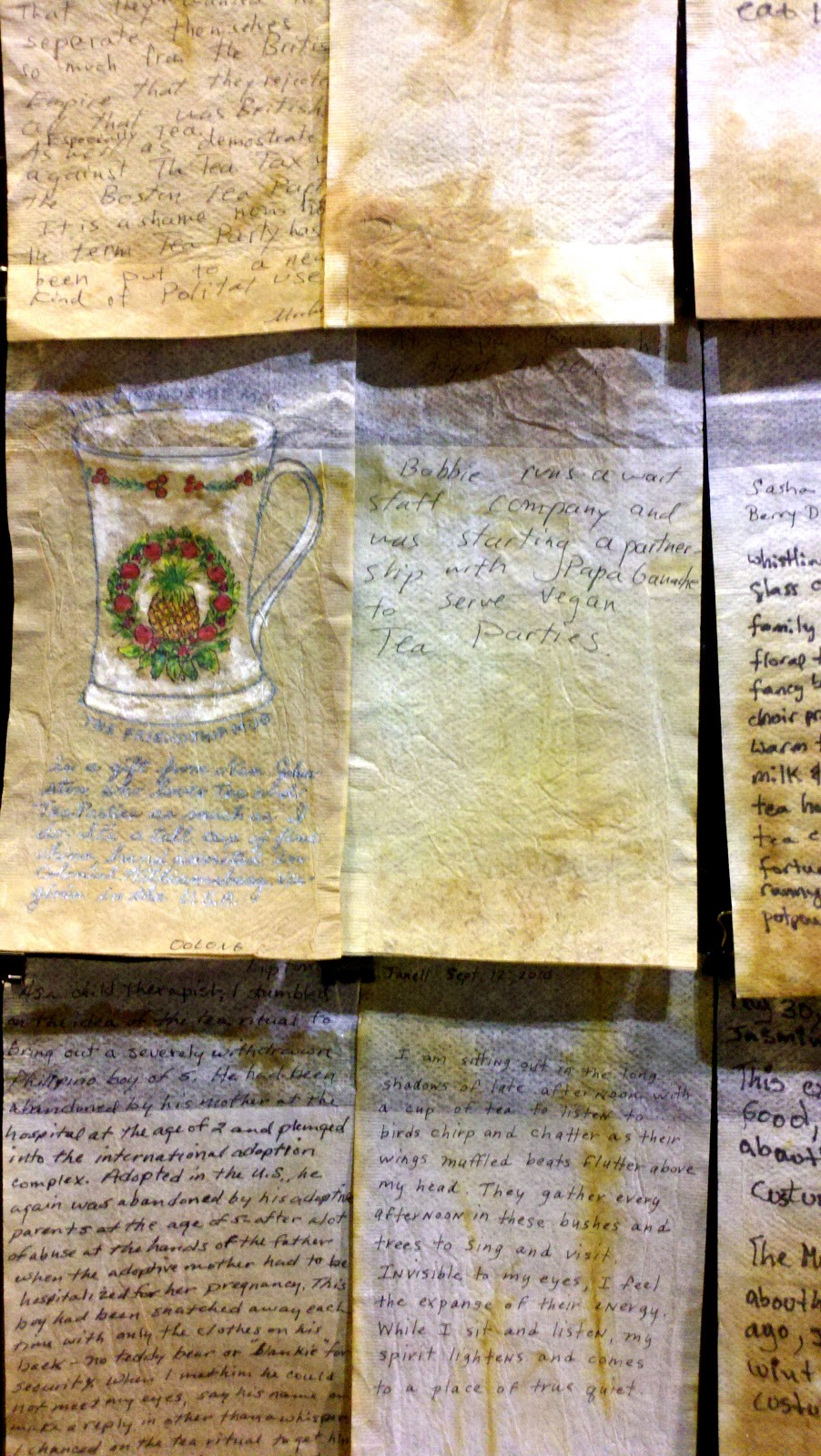
From Michele Brody's Reflections in Tea

NOTE:  Whoa!   Far too long between posts!   In case you're wondering, I  have not abandoned this blog, far from it -- I've just been side-tracked by a few trips out of town, long work hours, housecleaning projects, and, frankly, the temptation to play outside instead of sitting in front of a screen, now that Spring is here.  Lots of stockpiled GERD/guts/recipes/related topics ahead, so back to it, on a regular schedule, then!

After a few months of increased GERD and far too many TUMS, I am, somehow, feeling better.   Thank goodness, because a few weeks ago, I attended the 2013 NYC Coffee & Tea Festival (a sold-out frenzy that weighs heavily in favor of tea aficionados, with more leaf than bean again this year -- it's one of my annual highlights).  I wondered how my gut would handle more tea than usual, more black tea than usual, and more excitement than usual -- this year's festival coincided with a visit by my parents and an exceptionally hectic work-week.    

I am convinced after much trial and error that you can have your tea and your GERD, too -- you just need to figure out what works for your guts, tea-wise.  It may be drinking only with meals, avoiding strong black teas, or reducing the amount of tea/drinking it every few days, or perhaps going full-on herbal (I never thought I'd drink this much chamomile, but I've found a few varieties that are a delight).  As I've mentioned elsewhere on this blog, oolongs and pu-ehrs give me little to no problems, but YMMV.

THE TEA-HOUSE  

I started my festival day by wandering the aisles and found this at one end -- Michele Brody, a performance artist, engaged in Reflections in Tea, an interactive work where people enter a copper-and-teabag-lined structure to share a cup and stories of tea.  (For more on Michele's work and her Tea Reflections piece, see this interview from the Villager.)    The walls were created with tea-stained fillable tea-bags which had been covered with people's handwritten experience with tea.  I entered the structure, Michele's first participant of the day.   There was a calm but palpable energy in the tea-house, making me feel like I had entered a sacred space like a kiva or shaman's tent.   We shared cups of puehr and I was invited to write my own "reflection in tea."  (I wrote about navigating GERD as a tea-aficianado.)  

The tea-house:


Some of the "tea reflections" on used tea bags:


GREEN TEAS

I've been drinking a lot of green tea lately, usually mid-day and the afternoon.   My GERD tolerates "high quality" loose-leaf teas, particularly delicate ones.   One of the draws of the festival for me is buying from merchants I don't usually find in my local stores, like Sara's Tea Caddy, which specializes in fine-grade Japanese tea.   I sampled the Genmai Hojicha and should have purchased it, but splurged on the Fukamushi Sencha instead.  (Next time, I'll get both.)


I can tolerate high quality, delicate green tea.   While all loose-leaf is superior to pulverized tea in a sealed paper bag, I think GERD-wise, for me, it matters even more to seek out loose-leaf green tea, and a source that has been handled well.   I am steeping mine for about 1 minute, for a very light result.  Tip: If you want stronger tea, do not increase the steep time -- increase the amount of tea used.  (This applies to all tea.)


OOLONGS AND PUEHRS

The festival had many opportunities to try and buy my two favorite teas (as you may know from my earlier posts), puehrs and oolongs.   I especially liked the red oolong I sampled at Lotus Leaf Tea.  Here is one of the Lotus Leaf owners preparing a taste:


I bought the red tea and and a very rich puehr (shown below).   I learned some puehrs are artificially fermented with chemicals (!) (source for this pending, but that is what the Lotus Leaf purveyor told me); this one is naturally aged.  Another thing to consider when I buy puehrs!


One of my favorite New York tea suppliers was at the Festival -- Fang Gourmet Tea, a Chinese tea shop based in Flushing, Queens.  Fang's stand is always mobbed!   They have excellent tea in quality and variety, and the wonderful Fang staff gets a shout-out for perfectly matching one's tastes, budget and needs to the right tea.   I was tempted by a few of the costlier rare teas, but one of the tea sellers suggested I wait and come to their store where I can sample them -- make sure I like it before buying it. A trip to Queens is pending.  (Here is a nice article about Fang from Serious Eats.  And Fang's breadth of tea experience is demonstrated in this article about their pestle tea.)


I sampled the Four Season oolong, and decided to take a stronger variety home.   I drink oolong tea almost daily, with little impact on my GERD except in a positive way:  I feel calm, healthy, and happy when I drink it.  


A new Festival favorite, Everlasting Teas, is a company founded by a father-son team, Alan and Sammy Levine.  They stress unflavored teas, including a few rare varieties for the connoisseur (oolongs aged for over 30 years, etc.).  I was thrilled to be part of a small "tea tasting" at the stand, where we heard about each tea and tasted several varieties.   Sam's dad, Alan, had medical issues and drinking tea was one of the life-changes he made for better health.  (For more about Alan and Sam, see this blog entry from Chelsea Market Baskets, which also sells their teas.)

Alan and Sammy Levine at their stand, during a tasting.
Everlasting Teas -- exquisite selection and presentation!
 I picked up a Mountain Oolong and an aged oolong (Note: that is not me in the photo).


Another discovery for me at the Festival was The Tea Merchant, an organic, fair-trade tea company with the full variety of teas.  Full disclosure:  the booth invited bloggers to sample teas (and, one suspects, hopefully write about them) and I received samples of the Wuyi and Biodynamic Darjeeling.  I had GERD issues with the Darjeeling (see section on black teas, below), but enjoyed the Wuyi -- though I was a little underwhelmed, maybe due to my preference for Fang's and Everlasting Teas' varieties.


BLACK TEAS

Well, I think I've had it with black tea.  After sampling several stands at the fest, it was only when I consumed black tea that I started feeling my gut percolate.  Day to day, I avoid black teas except the occasional Tazo "Joy" tea (a blend of Darjeeling, Green and Oolong), and the Charleston plantation tea I picked up on our Southern road trip last year.  And then I drink them only late in the day, after I've had meals.

Still, at the festival, I was charmed by Ajiri Tea, a mother-daughter run company (with their dad/husband helping out at the booth) whose name means "to employ" in Swahili, and provides "a sustainable cycle of community employment and education" for women in Kenya.   (See The Mantle's interview for more about Ajiri's social mission.)  The boxes are works of art, literally, hand-crafted/designed by Kenyan artists and children.   I already had a box at home that I found at the Smithsonian, and was delighted to meet the Ajiri owners.   While I appreciate the high quality of this tea, I am forced to admit it is too harsh for my GERD sensitivity, and I cannot drink much of it.  So, I'll share the tea with friends, and enjoy the colorful boxes.


One of the most popular stands was the Bingley's Teas Limited booth, with its literature theme (teas are named after Victorian characters such as Mr. Knightly's Reserve), dramatic and detailed presentation (check out the photo below for tiny glimpse, and their Pinterest board), and -- unique, quality black teas.   I was tempted (by the self-titled Tea Temptress) by the Jane Austen Sampler, but decided to avoid buying black teas at the Festival (aside from Ajiri) since I am resigned to my inability to really drink them.  (Sigh.)  


My Festival bounty!